St. Louisans take an absurd amount of pride in the 1904 World’s Fair, which is almost comical to non-St. Louisans. We claim that both the Ice Cream Cone and the hot dog were invented at the World’s Fair, and that everything good in the world happened there.
Anyway, it turns out the ice cream cone was invented at the 1904 World’s Fair in St. Louis, at least if you believe Wikipedia. Apparently, one of the ice cream vendors ran out of serving containers. Syrian immigrant Ernest Hamwi rolled up some of his “zalabia” (a waffle-like pastry) from his pastry cart into cones and gave them to Arnold Fornachou, who had run out of paper dishes to serve his ice cream. The zalabia became an edible container. Word spread quickly through the Fair and many other vendors began selling ice cream in waffle cones.
1904 was a long time ago, when St. Louis was at its height as the country’s fourth-largest city. Ice cream cones are now ubiquitous countrywide, and St. Louis has no special claim on them. In 1929, Ted Drewes, Sr., one of the country’s most accomplished male tennis players decided he needed a side gig, and he opened a frozen custard stand in Florida. He spent his winters commuting to Florida and playing in tennis tournaments there.
Ted commuted between Florida and St. Louis and in 1930, opened his first St. Louis based custard stand on Natural Bridge near Goodfellow. Quickly, Ted Drewes became a St. Louis institution. Later, a second store on South Grand opened, but closed, with most other shops, amid white flight from North St. Louis in 1958.
Ted Drewes Frozen Custard is unquestionably the number one ice cream in St. Louis and will continue to fend off all challengers, from the fancy liquid nitrogen place to those upstart super-premium folks from Columbus (Jeni’s) trying to weasel their way in. It has a good formula, is family run–the fourth generation helps to run the store–and only two locations. It has a folksy, some would say cheesy advertising campaign, and really only one product, their vanilla frozen custard. As a bonus, the location of one of their stores is on the old Route 66 and they use that parking lot in November and December to sell Christmas Trees procured from Nova Scotia.
To get more information, on the operation, I went to visit, and got shown around by Josh Dillon, the great-grandson of Ted Drewes, Senior. First, we had a look at the deep freeze and the custard.
The custard as it arrives from Prairie Farms, with the secret recipe in the bag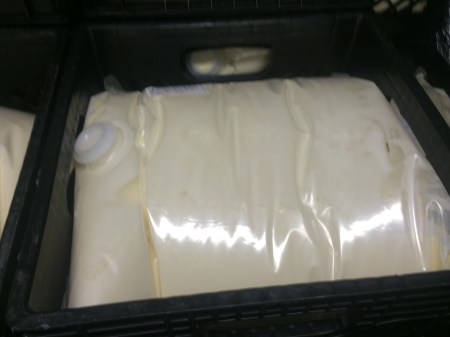
Prairie Farms makes the liquid custard according to Ted’s directions. Bags are run through the custard making machine, as seen the not so ideal picture below. The machine only makes one kind of custard, vanilla.
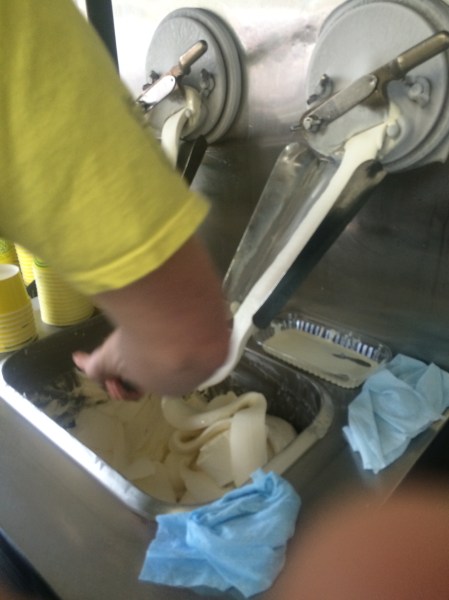
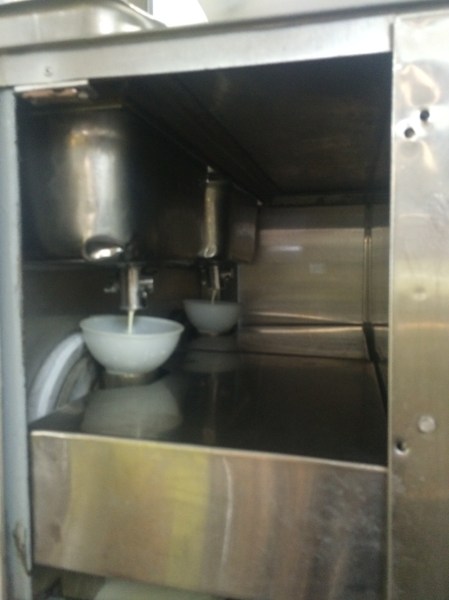
The custard is the base, and you can get whatever toppings you want with the custard, usually in the form of a concrete. The concrete, which for non-St. Louisans can best be described as a Dairy Queen Blizzard but so much better. The custard is the right combination of sweetness, creamy deliciousness and a touch of honey. Then you add in some other delicious ingredients, from 35-plus different individual flavors offered. Something like over half of all orders are a chocolate-chip concrete.
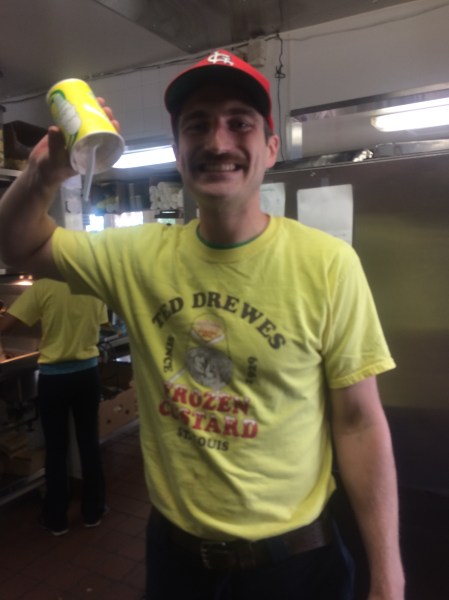
When you order, even on the hottest of summer days, the person at the counter will flip over the concrete before they hand it to you, and of course the custard stays inside. The full St. Louis experience is to sit in the hatchback or bumper of your car eating your concrete in the parking lot amidst the car exhaust, which heightens the flavor. You can taste the honey, the creaminess and the sweetness, and then each spoonful has a whole bunch of whatever your ingredient(s) of choice are as well. I have read that Ted Drewes uses honey, while others custard makers just use sugar. I tend to find each bite finishes with some concreteness, and one is rarely lacking for the mixed-in flavor; there are ample ingredients in each spoonful.
Each year the family goes through a process of discernment to figure out new flavors for the year, some named after celebrities, either real ones or St. Louis ones. According to Josh, they start out different flavors in February, with the goal to be ready by St. Patrick’s Day, where the new flavors debut, along with Shamrock and a Bunnycrete for Easter.
The vanilla base and the myriad of flavors allow for all sorts of mixing and matching, and hundreds if not thousands of potential options to suit all taste buds. During their tasting sessions, many more flavors end up on the cutting room floor. Josh said that celery tastes surprisingly good, but a Celerycrete is probably unmarketable, as folks really like their nuts and fruits. Feel free to try that at home or suggest new flavors during the winter.
The custard is so good that St. Louisans who have moved elsewhere must make the pilgrimage during a trip home, or get the custard sent to them over-nighted in dry ice. Just recently, they opened Ted Drewes’ vending machines in the airport terminals so you can get your fix the moment your plane lands back in the STL.
This being St. Louis in 2016, it seemed appropriate to ask the “scion-to-be” of a St. Louis Institution about the political economy of Ted Drewes.
When asked about the North City store closing and both stores being on the South Side of the Delmar Divide (the street across which few white St. Louisans venture), Josh had some thoughtful responses. He pointed out that there was also significant white flight away from the neighborhood where the South Grand store was located, and that Ted Drewes sees it as important to maintain the store there as an anchor, despite having lost significant business at that location years ago.
Ted Drewes has certainly had the opportunity to leave the city and set up shop in St. Louis County and has consistently refused to do so, seeing themselves as a business very tied to St. Louis City.
On diversity of employees, Josh said they were very committed to a diverse workforce and had relationships with a variety of local high schools to ensure a diverse workforce. The Chippewa (Route 66) location is much whiter than the Grand one because of who lives in that neighborhood, but they are cognizant of whom they are hiring and are trying to be representative.
On the question of whether Ted Drewes would reopen in North St. Louis, Josh talked about how it would be hard to open a third store. They have 20 full-time employees, and it is hard for them to provide enough hours in the wintertime. Adding the overhead of a third store does not make business sense, but that they might be interested in a North City distributorship arrangement. Any takers?
Oh, did I mention after the tour Josh asked me what I wanted and then handed me a banana chip concrete?
By way of introduction to this blog, I want to be real for a minute. The blog launch has been delayed twice because we felt uncomfortable posting relative frivolousness amidst the racist violence and murder happening around us. I have questioned whether it makes more sense to spend my precious free time writing about weightier subjects than ice cream.
As an organizer I am generally an optimist. Most working people, and small business owners are doing the best that they can. I am glad that Josh was willing to engage not just in the joy and wonder of why a celery concrete might be tasty, but also in an honest conversation about race in our region,
If, as Juliet notes, even Emma Goldman, can open an ice cream parlour, then I can write about it as part of my revolution too.

 The Splits
Great title.
LikeLike
I am filled with revolutionary fervor and I like mine with Heath bits, pistachio and chocolate chips.
LikeLike