
It was the summer of 2009 and we had just completed an alternatively arduous, breathtaking and luxurious four day trek to Machu Piccu After Machu Picchu, we were to take an overnight bus trip to La Paz, Bolivia. At our hostel, folks who had come from Bolivia warned us about the route. There had been a general strike over water privatization, and the roads on the way to the Bolivian border were blocked by those who were opposed to the government’s continued neoliberal policies. One traveler said they made it through, but only after beating the blockaders in a soccer match.
Of course, the bus company said the journey was just fine, maybe a few delays, but they had it figured out.
Like on any overnight bus trip, we stocked up on snacks and water for the trip and debated whether the strange guava snacks were better than whatever the different spiced corn options were. On overnight buses in Peru, seats are usually assigned. We had purchased the boletos de lujo, or luxury tickets, in the hope that having a seat decline halfway would give us a reasonable night’s sleep.
The first sign of trouble began as we boarded the bus.
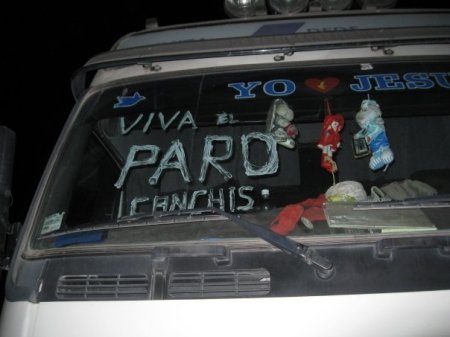 The bus was much smaller than we had thought, and the notion of assigned seats went right out the window. My travelling companion tried to pick a fight with some German backpackers about seat assignments, claiming that we had tickets for seats they had sat in. They scoffed at us, “Have you looked at this bus?” It was rather rickety and very small, with maybe only 30 seats “There are no luxury seats here, take what you get.”
I fell quickly asleep with the 9 pm departure, and slept through two hours of starting and stopping when the bus came to its final stop. The driver and the ticket taker asked everyone to get out. We got out and grabbed our luggage. A roadblock with burning tires flickered just a few hundred feet away. “Follow us,” someone said. And we walked, with backpacks and suitcases down the road, past the burning tires, rushing along. The same travelling companion who picked the fight about the luxury seats was preparing to spend two months in the campo of Paraguay, was schlepping a giant suitcase. The burning tires and the campfires of the blockade added to the confusion of us walking without knowing where we were and how far we were going.
After a half hour’s walk, we came to a moderately large flatbed pickup truck with wooden fencing around it. “Ok, everyone hop in,” they said. The truckbed was covered with straw. Somehow thirty of us clambered into the back of the truck, squeezed together in the cold night. At this point, the truck had all sorts of people inside, those who were taking the cross-border bus, and lots of local folks with small children and bags of corn in tow. They closed the back, put up some kind of tarp, and the truck took off.
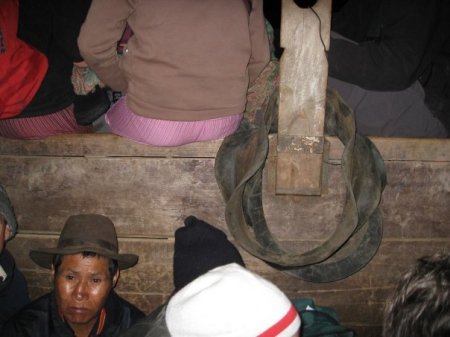 Maybe our sense of time and space was warped with the night, but the truck seemed to move at breakneck speed. It started careening up and down what were undoubtedly hairpin turns in the mountains. My other traveling companion, who was sitting diagonal from me, was in tears, convinced we were going to die. It certainly seemed possible. On the one hand, we could fall off the side of the mountain, and on the other, we were in some lawless part of the Campo, past a set of burning blockades, our only information was that most buses had not gotten through. And despite our personal politics likely aligning with the strikers, tourists are an easy mark for the cash needed to sustain these encampments.
The locals were taking it much better than us ,however. As many people as were jammed into the bed of the truck, there were others holding onto the sides, or dropping smaller family members into the truckbed.
After a couple hours of this crazy ride, we skidded to a stop. The tarp came off and the back opened up. We attempted as quickly as we could to adjust sore extremities that had fallen asleep as we grabbed our luggage and started walking. By this point, we knew the drill. We just needed to get our stuff across the burning tire blockades at the other end, which we did.
In what surely was a logistical coup, there was another bus waiting for us. This bus was even smaller, there were nowhere near enough seats for everyone, but we certainly could not hang out at the blockade and wait for the next one, nor were we willing to attempt to show our first class tickets anywhere.
I think we had one seat among the three of us, so I laid down on the floor by the wheel-well, and promptly slept soundly the rest of the night. We crossed the Bolivian border around 11 am the next morning, had a glorious lunch of fresh fish on Lake Titicaca and made it into La Paz at around 9 that evening. What should have been a 12 hour bus trip into a 24 hour one. The contrast of a few days in La Paz, under a (now overthrown) Leftist government, had never felt so tangible. From the government taking the side of telecommunications workers striking over corruption in management and taking over the company, to attending a municipally sponsored drag show. But these are all stories for another day.
 The Splits